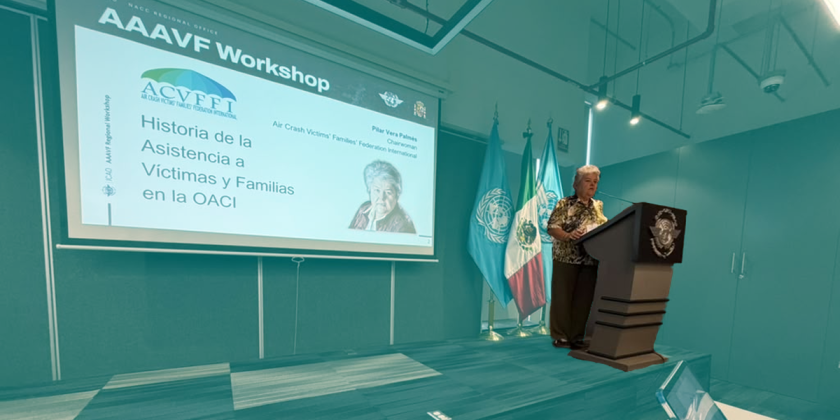
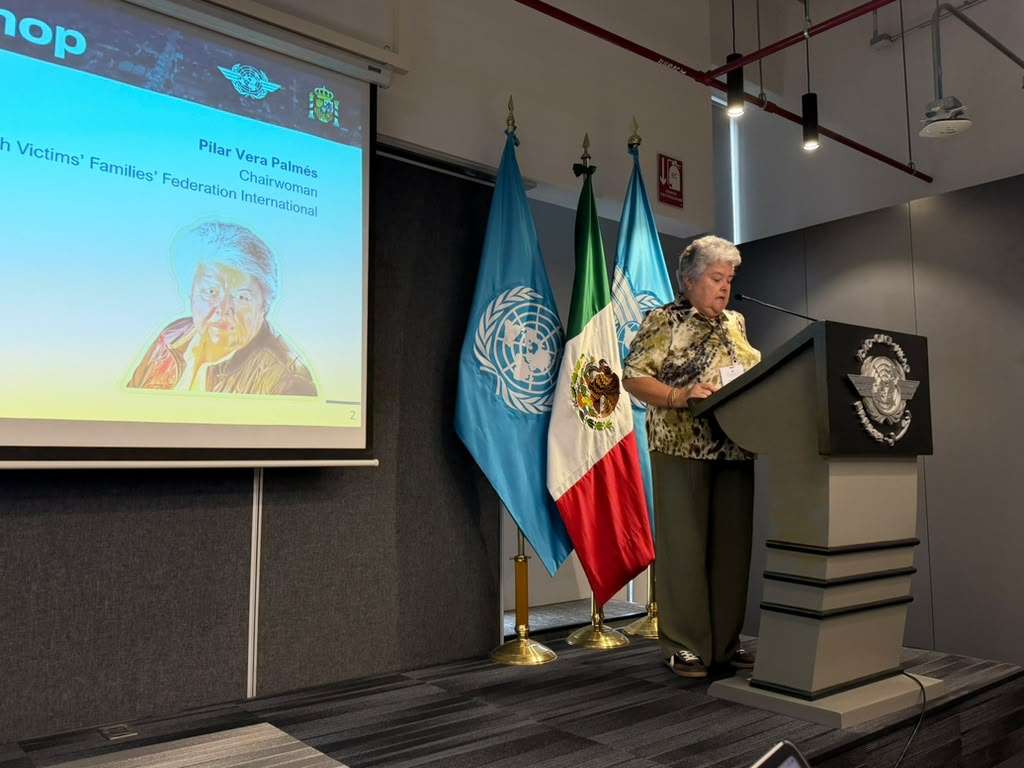
 The International Federation played an active role throughout the programme. In addition to Pilar Vera’s opening address on behalf of victims’ and families’ associations, <strong>Claudia Carrasco, Secretary General of ACVFFI</strong>, participated in technical sessions devoted to assessing national regulatory frameworks, identifying implementation gaps and conducting practical aviation accident response exercises.
During the workshop, participants addressed essential matters including:
- ICAO’s international framework for assisting victims and their families.
- The obligations arising from ICAO Annexes 9 and 13.
- The implementation of the ICAO Policy on Assistance to Aircraft Accident Victims and their Families, Doc 9998.
- The ICAO Manual on Assistance to Aircraft Accident Victims and their Families, Doc 9973.
- The preparation of Family Assistance Plans (FAPs).
- Coordination among States, airports, airlines and support organisations.
- Communication with families and the media during a crisis.
One of the recurring messages throughout the workshop was that international standards already exist. The remaining challenge in many countries is to incorporate these principles into national legislation and turn them into effective operational capabilities through training, exercises and permanent coordination mechanisms.
ICAO has had an international framework for assisting aircraft accident victims and their families for many years. Its principal instruments include Annex 9 on Facilitation, Annex 13 on Aircraft Accident and Incident Investigation, the ICAO Policy set out in Doc 9998 and the Assistance Manual contained in Doc 9973.
In addition, Resolution A42-15, adopted by the ICAO Assembly in 2025, calls upon States to enact legislation and review their systems in accordance with the Organization’s policy and manual.
The main problem, therefore, is not the absence of international guidance. The challenge is to incorporate that guidance into national legislation and convert it into operational plans, available resources, clearly identified responsibilities and regular preparedness exercises.
A document stored in a file does not protect any family. To be effective, a plan must be understood, verified, tested and regularly updated.
The next regional workshop will take place in Lima
The meeting in Mexico City represented an important first step towards promoting the implementation of family assistance plans among the States of the NACC Region.
This work will continue at the next workshop in Lima, Peru, where participants will continue to exchange experiences and promote the effective implementation of ICAO policies on assistance to victims and their families.
FaSA20 will continue to support ACVFFI’s international activities so that victims’ and families’ associations are represented in these processes and so that the commitments made during the workshops are translated into concrete measures by States.
Every approved standard, every national plan implemented and every preparedness exercise represents progress. However, true success will only be achieved when no family is left to face the consequences of an aviation accident alone.
FaSA20 reaffirms its support for ACVFFI and for the work it carries out before ICAO to promote safer, more responsible and more humane aviation.
